
“An artist friend of mine got me an AI-generated painting as a gift. I can see she tried to personalize the concept, and it’s nicely framed, but part of me still feels a little cheated. Is that fair?”
—No Returns
Dear No Returns,
There’s something implicitly paradoxical about feeling “cheated” by a present. A gift is, by definition, something that comes into your possession at no cost or effort, an object that exists outside the economic concepts of debt and fair exchange. But the fact that these offerings do often leave us feeling shortchanged suggests that there is a shadowy economics of gift giving, one whose rules are tacit and loosely defined. While I won’t pretend to know the nuanced history of obligations and credits that undergird your friendship, I think I can guess why the AI-generated painting disappointed you. First, the gift cost your friend nothing: The painting was presumably generated by one of the free diffusion models that are available online, and so required zero monetary sacrifice. Second, the gift demanded no real creative effort, beyond the idea for the prompt. Your friend is an artist, someone endowed with creative talent, yet she seemingly refused to contribute to your gift a portion of that private reserve. The artwork that resulted feels to you generic and impersonal, lacking the singular imprint of your friend’s creative mind.
Your question made me think of Lewis Hyde’s The Gift, a 1983 book about the role of art in market economies. While the writers and artists who have sung its praises (Margaret Atwood, Zadie Smith, and David Foster Wallace among them) tend to regard the book as something akin to a volume of metaphysics, it bills itself, somewhat dryly, as a work of economic anthropology. Hyde begins with a lengthy discussion of gift economies, like those found on the South Sea islands or among Indigenous Americans. While modern markets are defined by exactitude and reciprocity—it’s crucial that the seller receive compensation equal to the work they performed—gift economies, he argues, are not reciprocal but circular. The recipient of a gift isn’t expected to repay their benefactor directly, though it is assumed that they will contribute in some way to the community—to pay it forward, so to speak. Rather than fixating on fairness, such communities maintain a kind of faith that whatever you give will come back, though not directly or on a determined schedule. “When the gift moves in a circle its motion is beyond the control of the personal ego,” Hyde writes, “and so each bearer must be a part of the group and each donation is an act of social faith.”
Hyde’s larger point, which might be relevant to your question, is that artists tend to flourish in gift economies, where objects of art are regarded not as commodities with precise monetary values but as expressions of a communal energy, what Hyde calls “the commerce of the creative spirit.” The act of artistic creation is already in the tides of giving and receiving, because inspiration itself is drawn osmotically from an array of outside sources. We call talented people “gifted” because it’s understood that true creativity is unearned and unwilled—there are no private reserves. “We are lightened when our gifts rise from pools we cannot fathom,” Hyde writes. “Then we know they are not a solitary egotism and they are inexhaustible.” This is why any genuine encounter with art completely obliterates the usual logic of fairness and economic value. When you stand in awe of a Hokusai painting, you are not thinking, typically, about the price you paid for admission to the museum, or wondering about whether it was a good deal. The gift of these encounters leaves the recipient inspired to create something herself, and so the generative energy continues to pass from one person to another.
You alluded to the generic quality of the AI art you were given, despite your friend’s well-meaning attempts to personalize it. What’s interesting is that impersonality is a quality that characterizes both the very best and the very worst art: The transcendence one feels when listening to the Bach cello suites, say, or reading Sappho’s lyric poetry, perhaps stems from the feeling that the work’s genius was not generated by an individual mind, but drawn from the well of the collective unconscious. (Recall the scores of artists who have referred to themselves as “conduits” or “instruments,” insisting that they are merely the technological apparatus of some larger cosmic energy.)
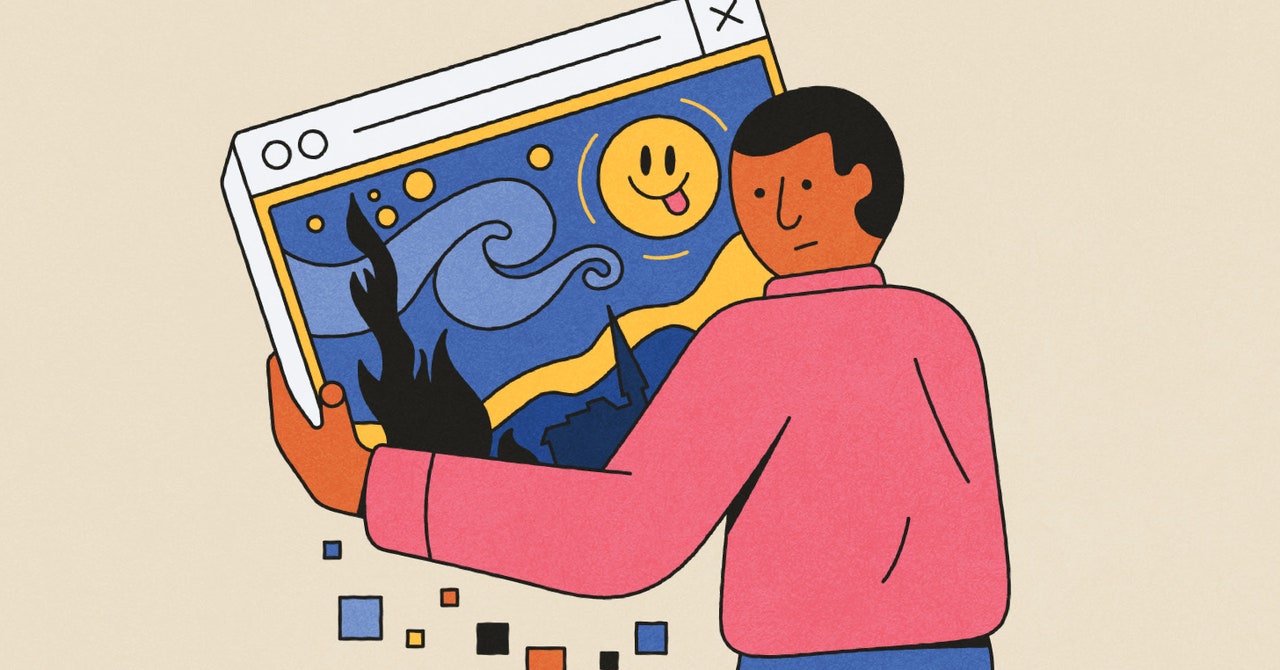
There’s a difference, though, between art that achieves a sublime universality and a product that is created to be benignly universal. The transpersonal quality of great art has its dark side in the vacuity of hotel paintings, Muzak, and formulaic paperback novels. I think it’s fair to say that AI-generated art, in its current stage of development, belongs to the latter category. Although it is drawing from “pools we cannot fathom,” to borrow Hyde’s formulation (an apt description of the vast reservoir of training data that constitutes the model’s unconscious), and although its stochastic logic is as opaque and mysterious as human creativity, its output still bears the stain of art that was created by committee and calculated to hit certain market objectives. If generative models were capable of creating something like an original van Gogh, then perhaps things would be different. As it stands, your friend gave you the digital equivalent of a Starry Night jigsaw puzzle.
Frequently Asked Questions
Why does the letter writer feel ‘cheated’ by their friend’s AI-generated painting gift?
The letter writer feels cheated for two main reasons: the gift cost their friend nothing, since it was presumably created using a free diffusion model available online, and it required no real creative effort beyond coming up with the prompt idea. Since the friend is an artist with creative talent, the recipient expected her to contribute some of that personal creative reserve, but instead received something that feels generic and impersonal.
What is Lewis Hyde’s book ‘The Gift’ about, and why does the author bring it up?
Lewis Hyde’s ‘The Gift’ is a 1983 book of economic anthropology that discusses the role of art in market economies, praised by writers like Margaret Atwood, Zadie Smith, and David Foster Wallace. The author references it because it explores gift economies, such as those on South Sea islands or among Indigenous Americans, which operate differently from modern markets, offering a framework to understand the ‘shadowy economics of gift giving’ that may explain why the AI-generated painting felt disappointing.
How do gift economies differ from modern markets according to Hyde, and what does this mean for artists?
According to Hyde, modern markets are defined by exactitude and reciprocity, where a seller must receive compensation equal to their work. Gift economies, by contrast, are circular rather than reciprocal — the recipient isn’t expected to repay the giver directly, but is expected to eventually contribute to the community in some way, trusting that what they give will eventually return to them, though not directly or on a set schedule. Hyde argues that artists tend to flourish in such gift economies, where art is seen as an expression of communal creative energy rather than a commodity with a precise monetary value.

1 comment
Your article helped me a lot, is there any more related content? Thanks! https://accounts.binance.com/en-ZA/register?ref=B4EPR6J0